
On this page
TL;DRKey facts, checked on Nov 27, 2026What does a SOC analyst do?What skills do you need to become a SOC analyst?Do you need a degree or experience to become a SOC analyst?What certifications do you need to be a SOC analyst?How long does it take to become a SOC analyst?How to become a SOC analyst with no experience: step-by-stepWhat should you practice before applying for SOC jobs?How do you get a SOC analyst job with no experience?Is being a SOC analyst hard, stressful, or worth it?SOC analyst career path and salary: what comes next?Our perspectivePractice with SecLernFAQCan you become a SOC analyst with no experience?How long does it take to become a SOC analyst?What certifications do I need to be a SOC analyst?Do you need a degree to become a SOC analyst?Is being a SOC analyst stressful?How much does a SOC analyst make?SourcesRecommendedA SOC analyst is a blue-team security professional who monitors alerts, triages incidents, documents evidence and escalates real threats. How to become a SOC analyst without relying on a degree or bootcamp: learn networking and operating-system basics, earn one baseline certification such as CompTIA Security+ or Network+, practice alert triage in labs, and publish three investigation writeups. From zero, plan on roughly 9 to 15 months of part-time study at 10 to 15 hours a week, then apply before you feel fully ready.
TL;DR
- A SOC analyst is a blue-team professional who monitors alerts, triages incidents, documents evidence and escalates confirmed threats.
- No degree or certification is legally required; most beginners need networking and OS fundamentals, one baseline cert such as Security+ or Network+, and hands-on triage practice.
- CompTIA Security+ SY0-701 has a maximum of 90 questions, a 90-minute limit and a passing score of 750 on a 100–900 scale; Security Operations is 28% of the exam.
- From zero, a planning estimate is 9 to 15 months at 10 to 15 study hours a week; apply before you feel fully ready.
- Three deep investigation writeups, such as phishing, a packet capture, and a SIEM query mapped to MITRE ATT&CK, give interviewers more evidence than a wall of entry-level certificates.
Key facts, checked on Nov 27, 2026
- CompTIA Security+ SY0-701 has a maximum of 90 questions and a 90-minute time limit, and the passing score is 750 on a 100–900 scale; Security Operations is 28% of the exam. CompTIA Security+ (SY0-701) certification page ↗
- CompTIA Network+ N10-009 has a maximum of 90 questions and a 90-minute time limit, and the passing score is 720 on a 100–900 scale. CompTIA Network+ (N10-009) certification page ↗
- The U.S. Bureau of Labor Statistics classifies information security analysts under Standard Occupational Classification code 15-1212 and describes a bachelor's degree as typical. BLS Occupational Outlook Handbook: Information Security Analysts ↗
- NIST SP 800-61 Rev. 2 defines four incident-response phases: preparation; detection and analysis; containment, eradication, and recovery; and post-incident activity. NIST SP 800-61 Rev. 2: Computer Security Incident Handling Guide ↗
- MITRE ATT&CK is a knowledge base of adversary tactics and techniques based on real-world observations. MITRE ATT&CK ↗
What does a SOC analyst do?
A SOC analyst monitors security alerts, investigates whether they are real, documents the evidence and escalates confirmed incidents. The job sits inside a security operations center, the team and tooling that watch an organization's endpoints, identities, network and cloud accounts.
Tier 1 is the entry point. You watch SIEM (security information and event management) and EDR (endpoint detection and response) dashboards, work the phishing queue, validate alerts, gather evidence, open and close tickets, and escalate what looks real. Tier 2 goes deeper: scoping, containment and more complex investigation. Tier 3 and threat hunters look for activity that has not triggered an alert and tune detections.
Job posts may use SOC analyst, security operations center analyst and information security analyst in overlapping ways. The U.S. Bureau of Labor Statistics groups the work under information security analysts, Standard Occupational Classification code 15-1212. The work is defensive, not penetration testing.
A reality check: many Tier 1 teams run 24/7 shifts, and documentation and communication matter as much as tool knowledge. If you dislike writing a clear ticket, the job will feel harder than the alerts do.
What skills do you need to become a SOC analyst?
You need enough networking, operating-system and log-reading skill to answer three questions about an alert: what happened, which systems are involved, and what should happen next.
| Skill | What entry-level looks like | How to practice |
|---|---|---|
| Networking | Read source and destination IPs, DNS queries, HTTP requests and ports such as 53/UDP, 80/TCP and 443/TCP. | Draw the packet path for real alerts. Use ip addr, ping, nslookup and Wireshark filters. |
| Windows and Linux | Find logon events, process trees and authentication activity in Event Viewer, Sysmon, journalctl and /var/log/auth.log. | Reproduce a failed logon and a successful logon, then explain the difference in a timeline. |
| Security fundamentals | Explain phishing, malware, the CIA triad, alert severity and the incident-response lifecycle. | Map sample alerts to MITRE ATT&CK, a knowledge base of adversary tactics and techniques based on real-world observations. |
| SIEM and EDR | Search by user, IP or file hash; pivot from an alert to surrounding events. | Build one query that shows all activity for a user in a day, then write down what looks normal. |
| Packet and log analysis | Read firewall, proxy, DNS and PCAP evidence without guessing. | Open a sample PCAP in Wireshark, filter for one host, and write a three-line summary. |
| Writing and communication | Produce a ticket with summary, timeline, evidence, verdict and escalation path. | Rewrite one messy investigation as a one-page ticket a shift partner could pick up. |
The tools matter less than the reasoning. A candidate who can explain why a failed logon burst is not the same as a successful compromise is more useful than one who memorized a dashboard name. Do not wait for perfect tool knowledge before you start practicing.
Do you need a degree or experience to become a SOC analyst?
No degree or license is legally required to work as a SOC analyst; employers set their own requirements, and a strong lab portfolio or relevant IT experience can substitute for a degree at some Tier 1 and managed security service provider (MSSP) roles.
The U.S. Bureau of Labor Statistics describes a bachelor's degree in computer and information technology or a related field as typical for information security analysts, the closest official occupational category, and lists Standard Occupational Classification code 15-1212. Typical is not the same as mandatory. Read local job posts before you commit to a program.
Useful degrees include information technology, cybersecurity and computer science. An associate's degree plus certifications and a strong lab portfolio can work for some Tier 1 and MSSP roles. Experience substitutes include help desk, network operations center (NOC), IT support, internships, home labs and freelance troubleshooting. Customer-service and ticket experience are relevant because SOC work is queue work with a security label.
Do not take on major debt for a bootcamp or degree without checking real job postings in your market. Pair any credential with evidence that you can triage an alert end to end. If you need projects that count as experience, see how to get hands-on IT experience without a job.
What certifications do you need to be a SOC analyst?
No certification is legally required to be a SOC analyst, but one baseline certification plus one platform-specific certification is enough for most entry-level filters.
Exam versions change, so confirm details on the linked pages.
| Certification | Why it helps | When to take it | Verified details |
|---|---|---|---|
| CompTIA Network+ N10-009 | Builds the networking base you need to read alerts. | First if networking is weak. | Maximum 90 questions, 90 minutes, passing score 720 on a 100–900 scale, per CompTIA. |
| CompTIA Security+ SY0-701 | Broad security baseline and a common entry-level cert for SOC roles. | After Network+, or first if networking is solid. | Maximum 90 questions, 90 minutes, passing score 750 on a 100–900 scale; Security Operations is 28% of the exam, per CompTIA. |
| CompTIA CySA+ | Intermediate blue-team certification. | After Security+ or early in a SOC role. | Check CompTIA for the current exam version and objectives. |
| Microsoft SC-200 | Microsoft Security Operations Analyst credential for Sentinel and Defender environments. | After a baseline cert, especially for Microsoft-heavy employers. | Earned by passing Exam SC-200, per Microsoft. |
| Cisco CCNA 200-301 | Useful for network-heavy SOC or NOC roles. | Optional, unless your target jobs ask for it. | 120-minute exam, per Cisco. |
If you choose one, most beginners should start with Security+; start with Network+ if networking fundamentals are missing. Add CySA+ or SC-200 later. If a Security+ version change is near, compare SY0-701 vs SY0-801 before booking.
Guided practice options differ. TryHackMe's SOC Level 1 path is structured browser-based defensive training. LetsDefend offers a SOC analyst learning path and hands-on alerts. Security Blue Team's BTL1 is a hands-on defensive certification. The Google Cybersecurity Professional Certificate is a broader introductory certificate. None replaces deep investigation writeups.
How long does it take to become a SOC analyst?
There is no official timeline to become a SOC analyst; a reasonable planning estimate is 9 to 15 months from zero at 10 to 15 study hours a week, and less if you already work in IT.
| Background | Realistic study runway | What shortens it |
|---|---|---|
| No IT or security experience | 9 to 15 months | Consistent weekly hours, one baseline cert, and a batch of triage writeups. |
| 1 to 2 years help desk or NOC | 4 to 8 months | Ticket evidence, troubleshooting stories, and an internal move. |
| Recently completed IT or cybersecurity degree or bootcamp | 3 to 6 months | Labs and portfolio proof, not just coursework. |
| Security+ already earned | 2 to 4 months | 20 to 30 triaged alerts, three writeups, and active applications. |
These are planning estimates, not guarantees. Add 1 to 3 months for applications and interviews. Local market, clearance requirements, shift availability and the number of roles you apply to can move the timeline more than another certificate will.
Apply before you feel 100% ready. A help-desk-to-SOC internal move can shorten the path because you already have ticket and troubleshooting evidence.
How to become a SOC analyst with no experience: step-by-step
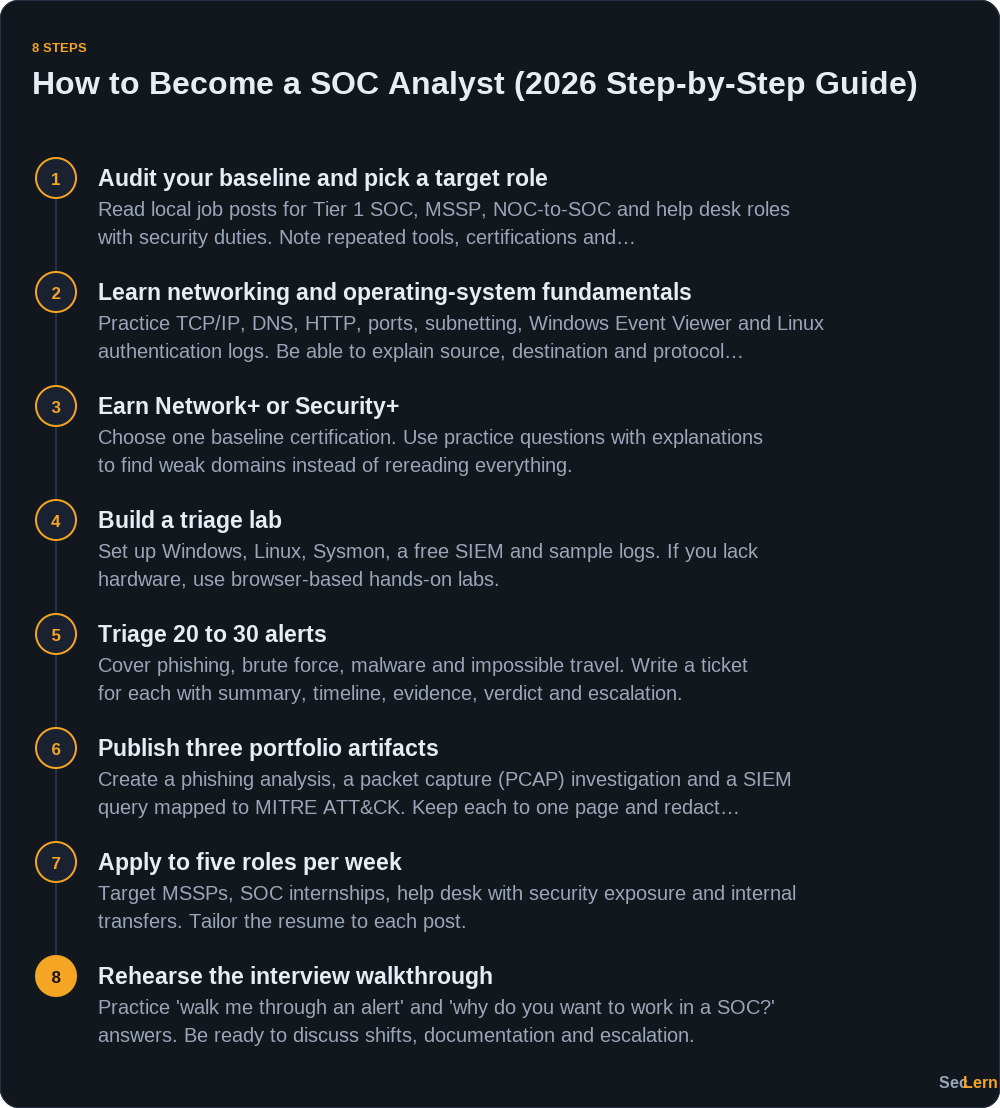
A credible route is to build baseline skills, earn one certification, triage a batch of realistic alerts, publish evidence, and apply while you keep practicing.
- Audit your baseline and pick a target role (week 1). Read local job posts for Tier 1 SOC, MSSP analyst, NOC-to-SOC and help desk with security duties. Note repeated tools, certifications and shift requirements.
- Learn networking and operating-system fundamentals (weeks 2–6). Practice TCP/IP, DNS, HTTP, ports, subnetting, Windows Event Viewer and Linux authentication logs. If you cannot explain source, destination and protocol in an alert, stop and fix that.
- Earn Network+ or Security+ (weeks 6–14). Take one baseline certification. Use practice questions with explanations to find weak domains instead of rereading everything.
- Build a triage lab (weeks 10–14). Set up Windows and Linux, Sysmon, a free SIEM and sample logs. For a starting plan, see cybersecurity hands-on training. If you have no spare hardware, use browser-based hands-on labs.
- Triage 20 to 30 alerts and write a ticket for each (weeks 14–20). Cover phishing, brute force, malware and impossible travel. Use a consistent format: summary, timeline, evidence, verdict and escalation.
- Publish three portfolio artifacts. Create a phishing analysis, a packet capture (PCAP) investigation and a SIEM query with MITRE ATT&CK mapping. Keep each to one page and redact sensitive data.
- Apply to five relevant roles per week. Target MSSPs, SOC internships, help desk with security exposure and internal transfers. Tailor the resume to each post.
- Rehearse the interview walkthrough. Practice 'walk me through an alert' and 'why do you want to work in a SOC?' answers. Be ready to discuss shift work, documentation and what you would escalate.

What should you practice before applying for SOC jobs?
Practice the investigations that fill Tier 1 queues: phishing, suspicious logons, malware alerts, network connections and SIEM pivots. Keep a written ticket for each one.
| Scenario | Tools and logs | Evidence to show a hiring manager |
|---|---|---|
| Phishing triage | Email headers, URLs, attachments, SPF, DKIM and DMARC results | A verdict, the indicators you checked, what the user clicked, and the ticket. |
| Windows logon anomaly | Event Viewer, Sysmon, successful and failed logons, parent and child processes | A timeline, affected accounts, scope, and whether you would escalate. |
| Linux authentication | SSH failures, sudo use, successful logins, journalctl, /var/log/auth.log | A clear distinction between brute force and a successful compromise. |
| Network alert | Firewall or intrusion detection system (IDS) alert, packet capture (PCAP) in Wireshark, DNS and HTTP logs | Source, destination, protocol, data touched, and containment decision. |
| SIEM pivot | Queries by user, IP or file hash | How you built the timeline, assigned severity, and mapped activity to MITRE ATT&CK. |
| Incident writeup | Ticket notes, evidence, timeline, escalation memo | Activity mapped to the NIST SP 800-61 Rev. 2 phases: preparation; detection and analysis; containment, eradication, and recovery; and post-incident activity. |
Three deep investigations beat thirty shallow certificates. Use browser labs if you do not have a VM, and keep screenshots with short writeups. A hiring manager should be able to open one page and see how you think.

How do you get a SOC analyst job with no experience?
You get hired by making your resume and interview answers prove that you can do Tier 1 work, not by waiting until you feel ready.
- Rewrite the resume around evidence. Put ticket volume, users supported, troubleshooting scope, tools used and lab projects near the top. 'Monitored a SIEM' is weak; 'triaged 24 phishing alerts and escalated 3' is inspectable.
- Use job-post keywords honestly. SIEM, EDR, phishing triage, MITRE ATT&CK, incident response, TCP/IP, Windows and Linux should appear only where you have real experience or lab work.
- Target the entry doors. MSSPs, Tier 1 SOCs, SOC internships, NOC roles and internal help-desk transfers often hire for first roles. Smaller employers may train more.
- Network with proof. Share a redacted writeup on LinkedIn or in a security community, ask for feedback, and ask for referrals after you have shown work.
- Prepare the interview stories. Answer 'Why SOC?' with curiosity and shift realism. Walk through a full alert lifecycle. Ask about training, escalation paths and tier progression.
- Do not wait for perfect. Apply before you feel 100% ready, and do not pay for an expensive bootcamp without checking real outcomes from people who took it.
Is being a SOC analyst hard, stressful, or worth it?
Tier 1 SOC work is learnable and can be worth it as a blue-team entry, but it can also be repetitive and stressful, especially at understaffed MSSPs with 24/7 shifts and high alert volume.
Alert fatigue is real: many alerts are benign, but you cannot skip the checks that separate noise from a real incident. Shift work affects sleep and social life. Documentation can feel like a chore until you realize it is the product your team hands to Tier 2.
The work is not elite hacking. Process, curiosity and clear writing matter more at entry level than reverse engineering malware. It is a good fit if you like puzzles, logs and tickets, and a poor fit if you want penetration testing from day one.
On pay, the U.S. Bureau of Labor Statistics publishes median annual pay for information security analysts, the closest official category, not a separate SOC analyst figure. The number updates annually and is not specific to entry-level SOC roles. Check current BLS data and local postings, and ask about shift differentials.
To improve, review every escalated ticket, learn one SIEM deeply, map alerts to attacker techniques and ask for feedback on your writeups.
SOC analyst career path and salary: what comes next?
The usual SOC analyst career path moves from Tier 1 triage to Tier 2 investigation, then Tier 3 threat hunting or a specialization such as detection engineering, incident response or cloud security.
| Role | Typical experience | Main focus |
|---|---|---|
| Tier 1 SOC analyst | 0 to 2 years | Alert triage, ticket quality, evidence collection and escalation. |
| Tier 2 SOC analyst | 1 to 3 years | Deeper investigation, containment support and incident coordination. |
| Tier 3 or threat hunter | 3 to 5 years | Proactive hunting, hypothesis testing and detection improvement. |
| Detection engineer, incident response or cloud security | 3 to 5+ years | Specialized detection, response or cloud controls. |
| SOC manager | 5+ years | People, process, metrics, coverage and reporting. |
The experience ranges are planning estimates, not rules. Certification progression often looks like Security+ then CySA+ then SC-200 or a cloud-security certification. Experience and portfolio artifacts outweigh collecting more entry-level certificates.
Salary grows with tier, specialization, shift differential and location. The U.S. Bureau of Labor Statistics is a benchmark for the broader information security analyst category, not a SOC-specific guarantee. Keep a brag sheet of incidents, tickets and lab projects and update it monthly so promotions and interviews do not depend on memory.
Our perspective
We built SecLern around a simple observation: people who can talk about alert triage are common, and people who can show a clean ticket are not. Watching a SOC walkthrough feels productive, but hiring managers cannot inspect a video you watched. They can inspect a one-page phishing analysis, a PCAP timeline, or a SIEM query with a verdict. Our bias is to make you produce artifacts early. The trade-off is that labs and writeups take longer than a course completion badge, and nobody enjoys rewriting a messy ticket. Do it anyway. Three careful investigations give you better interview material than a stack of introductory certificates.
Practice with SecLern
SecLern helps you build evidence a SOC hiring manager can inspect. The CompTIA Security+ SY0-701 study page covers the baseline domains, and browser-based hands-on labs let you practice on a simulated Windows, Linux and Cisco desktop without a VM or cloud account. The free tier needs no card and includes the first module of each path, 30 questions a day, 3 labs and performance-based questions (PBQs), and unlimited flashcards. Pro is $15 a month or $99 a year with a 7-day trial (card required); Exam Sprint is $29 once for 90 days. See pricing.
FAQ
Can you become a SOC analyst with no experience?
Yes, but you need evidence that you can do the work. Start with networking and operating-system fundamentals, earn one baseline certification such as CompTIA Security+ or Network+, triage 20 to 30 realistic alerts in labs, and publish three investigation writeups. Help desk, NOC, internships and MSSP roles are common entry doors. A degree alone is not a guarantee, and no certification is legally required.
How long does it take to become a SOC analyst?
There is no official timeline. A planning estimate at 10 to 15 study hours a week is 9 to 15 months from zero, 4 to 8 months from a help desk or NOC role, 3 to 6 months from an IT or cybersecurity degree or bootcamp, and 2 to 4 months if you already hold Security+. Add 1 to 3 months for applications and interviews.
What certifications do I need to be a SOC analyst?
No certification is legally required. Most beginners should choose one baseline: CompTIA Security+ for broad security coverage, or Network+ first if networking is weak. For SY0-701, the exam has a maximum of 90 questions, 90 minutes and a passing score of 750 on a 100–900 scale; confirm the current version on CompTIA's page. Add CompTIA CySA+ or Microsoft SC-200 later if your target employers use blue-team or Microsoft tools.
Do you need a degree to become a SOC analyst?
No. Employers set their own requirements, and the U.S. Bureau of Labor Statistics describes a bachelor's degree in computer and information technology or a related field as typical for information security analysts, not mandatory. An associate's degree, certifications, help-desk experience and a strong lab portfolio can work for some Tier 1 and MSSP roles. Check local postings before taking on debt.
Is being a SOC analyst stressful?
Tier 1 can be stressful because alert queues are high-volume and many SOCs run 24/7 shifts. Alert fatigue and documentation load are real, especially at understaffed MSSPs. The work is still learnable: process, curiosity and clear writing matter more than elite hacking. It suits people who like puzzles, logs and tickets, and less so people who want penetration testing from day one.
How much does a SOC analyst make?
The U.S. Bureau of Labor Statistics publishes median annual pay for information security analysts, the closest official category, not a separate SOC analyst figure. Entry-level SOC pay varies by region, employer, shift differential and specialization, so check current BLS data and local job postings. Do not treat a single online salary number as a guarantee for a Tier 1 role.
Sources
- CompTIA Security+ (SY0-701) certification page
- CompTIA Network+ (N10-009) certification page
- CompTIA CySA+ certification page
- Microsoft Certified: Security Operations Analyst Associate
- Cisco CCNA certification page
- BLS Occupational Outlook Handbook: Information Security Analysts
- NIST SP 800-61 Rev. 2: Computer Security Incident Handling Guide
- MITRE ATT&CK
- TryHackMe SOC Level 1 path
- LetsDefend