
On this page
TL;DRWhat are self-study certifications?Is a self study certificate the same thing?Self-study vs coaching: which is better?Which IT certifications can you self-study for?How do you choose a certification to self-study for?Pick this if you are starting from...How do you build a self-study plan around the exam objectives?Worked example: a 70-hour Security+ planHow long does it take to self-study for a certification?How do you practice for a self-study exam without a class?Which free self-study resources are actually worth your time?What mistakes sink self-study attempts?Self-study certification checklistOur perspectivePractice with SecLernFAQAre self-study certifications recognized by employers?Can I put a self-study certification on my resume?What is a self-study certificate (NIOS) and is it the same thing?How many hours a day should I study for an IT certification?Is self-study enough to pass Security+ with no IT experience?What is the cheapest way to get an IT certification?SourcesRecommendedSelf-study certifications are IT credentials you prepare for on your own, using the certifying body's free exam objectives as the syllabus instead of a required instructor-led course. No CompTIA, Cisco, AWS, Microsoft or ISC2 exam makes you buy training before you register: the objectives, domain weights and exam format are published free, so the only mandatory costs are the exam fee and whatever study material you choose. This guide is about IT credentials. If you searched for a NIOS "self study certificate", that is a school-board document, not a certification.
TL;DR
- Self-study certifications are IT credentials you prepare for alone, and no CompTIA, Cisco, AWS, Microsoft or ISC2 exam requires a course before you can register.
- CompTIA publishes free exam objectives with domain percentages for every certification, which makes each one usable as a syllabus.
- CompTIA Security+ (SY0-701) is a maximum of 90 questions in 90 minutes, with a passing score of 750 on a 100-900 scale.
- Allocate study hours by published domain weight: Security Operations is 28% of SY0-701, General Security Concepts only 12%.
- Certifying bodies publish exam length, not required study hours, so every week-by-week timeline is an estimate.
- A NIOS self study certificate is a school-board document in India, not an IT certification.
What are self-study certifications?
A self-study certification is an IT credential you prepare for independently, using the published exam objectives as your syllabus. No instructor, cohort or attendance requirement is involved.
Three things make that work for IT exams:
- Free objectives with weights. CompTIA publishes official exam objectives for every certification as a free download, including each domain's percentage. Cisco, AWS, Microsoft and ISC2 publish equivalents.
- A published exam format. Question count, time limit and passing score sit on the certifying body's page, so you can rehearse the real format.
- No training prerequisite at registration. You book the exam and pay the fee; nobody checks how you prepared.
Is a self study certificate the same thing?
No. Searches for "self study certificate format" and "self study certificate NIOS" usually mean a school-board document. NIOS, India's National Institute of Open Schooling, issues school-level certificates, not IT credentials. The phrase "self-paced certifications online" only describes how a course is delivered.
The certificate is identical either way. It carries your name, the exam and the date, and it does not record how you studied.
Self-study vs coaching: which is better?
Self-study wins on cost and pace, coaching wins on structure and accountability, and a common route is a hybrid of the two.
| Factor | Self-study | Coaching or bootcamp | Hybrid |
|---|---|---|---|
| Cost | Exam fee plus chosen material | Exam fee plus course fee | Exam fee, one resource, one question bank |
| Schedule | Yours, easy to drift | Fixed class dates | Fixed exam date, flexible blocks |
| Accountability | None unless you build it | Instructor and cohort | Booked exam plus weekly checkpoints |
| Feedback | Whatever your resources include | Often included | Explained questions and labs |
| Main risk | Never booking, resource hoarding | Paying and still not sitting | Doubling up on material |
The honest failure mode of self-study is drift: you collect five resources, watch two, never book, and restart every few months. The rest of this article is the fix. Exam day is identical either way, with the same exam and the same passing score.
Which IT certifications can you self-study for?
Every certification in this table can be self-studied, because each vendor publishes its exam objectives free and none requires a class before you register.
| Certification | Exam code(s) | Questions | Time | Level and best for |
|---|---|---|---|---|
| CompTIA A+ | 220-1201 (Core 1) and 220-1202 (Core 2) | Max 90 per exam | 90 minutes per exam | Entry level; first IT job |
| CompTIA Network+ | N10-009 | Max 90 | 90 minutes | Entry to mid; networking fundamentals |
| CompTIA Security+ | SY0-701 | Max 90 | 90 minutes | Entry-level security roles |
| CompTIA CySA+ | CS0-003 | Max 85 | 165 minutes | Mid level; SOC analyst |
| Cisco CCNA | 200-301 | Not published | 120 minutes | Mid level; network engineer |
| AWS Solutions Architect Associate | SAA-C03 | 65 | 130 minutes | Mid level; cloud architect |
| Microsoft Azure Fundamentals | AZ-900 | Not published | Check Microsoft Learn | Entry level; cloud basics |
| ISC2 CISSP | CISSP | 100-150, adaptive | 3 hours | Advanced; security management |
Passing scores sit on the same pages: 675 and 700 on a 100-900 scale for A+ Core 1 and Core 2, 720 for Network+, 750 for Security+, 750 for CySA+, 720 out of 1000 for AWS SAA-C03, and 700 out of 1000 for CISSP. CCNA and AZ-900 do not publish a question count, so treat any exact number you see elsewhere as a guess.
One real gate sits in the table. CISSP can be studied alone, but certification needs five years of cumulative paid experience in two or more of its eight domains, with a four-year degree or an approved credential waiving one year, according to ISC2's CISSP page. CompTIA also recommends Network+ plus two years of IT administration experience with a security focus before Security+, per its Security+ page.

How do you choose a certification to self-study for?
Choose by working backward from job ads for the role you want, then check the official objectives to see whether the level fits.
- Read ten job ads for the target role. Note which certifications repeat; one ad is noise, five is a pattern.
- Match the level. Entry: A+, Network+, AZ-900. Mid: Security+, CCNA, CySA+, AWS SAA-C03. Advanced: CISSP, CISM.
- Skim the official objectives. If every line reads as alien, step down a level. CompTIA's objectives downloads are free.
- Check the real prerequisite. Most of these exams have none at registration; CISSP has an experience requirement, and CompTIA recommends Network+ before Security+.
- Check the fee and scheduling on the vendor page, since fees vary by country and change.
- Commit to one certification and stop shopping. Two half-finished paths teach less than one finished path.
Pick this if you are starting from...
- A career change with no IT background: A+ first, because it covers hardware, operating systems, networking and troubleshooting, and it shows up in many entry-level job ads.
- A help-desk job: Network+ or Security+, depending on whether the roles you want are network-titled or security-titled.
- Software development moving to cloud: AWS SAA-C03 for AWS shops, AZ-900 as a shorter first step for Azure shops.
A free which certification fits me tool narrows it by background and target role, and entry-level IT certifications covers the first step in more detail.
How do you build a self-study plan around the exam objectives?
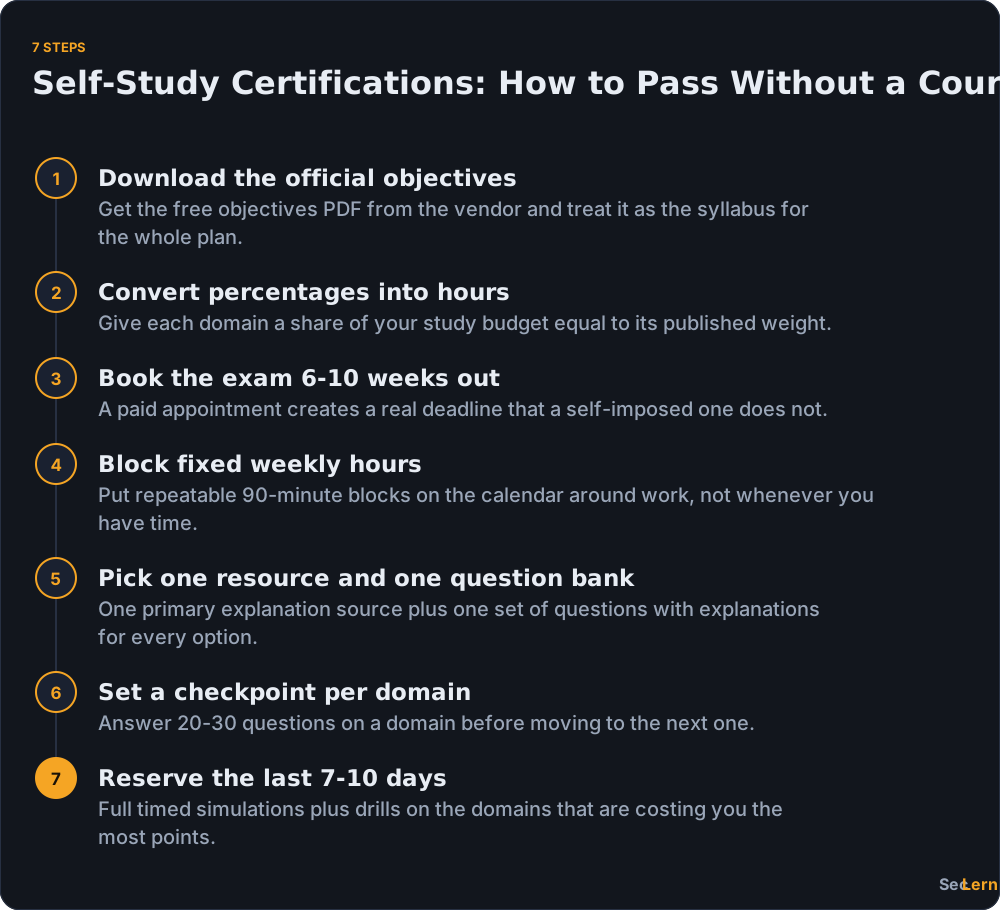
Build the plan from the official objectives: turn each domain percentage into study hours, book an exam date, and put a practice checkpoint at the end of every domain.
- Download the official objectives PDF. Free from CompTIA, Cisco, AWS, Microsoft and ISC2.
- Convert percentages into hours. A domain worth 28% of the exam gets about 28% of your budget.
- Book the exam six to ten weeks out. A paid appointment creates a deadline a calendar reminder cannot.
- Block fixed weekly hours. Three 90-minute blocks beat "whenever I have time"; how to study while working full time has a schedule built around a job.
- Pick one primary resource and one question bank. More than that is hoarding.
- Set a checkpoint per domain. Twenty to thirty questions on that domain before you move on.
- Reserve the last 7-10 days for full timed simulations and weak-domain drills.
Worked example: a 70-hour Security+ plan
The SY0-701 objectives weight the five domains, and a 70-hour budget maps onto them like this:
| Domain | Weight | Hours out of 70 |
|---|---|---|
| Security Operations | 28% | About 20 |
| Threats, Vulnerabilities and Mitigations | 22% | About 15 |
| Security Program Management and Oversight | 20% | About 14 |
| Security Architecture | 18% | About 13 |
| General Security Concepts | 12% | About 8 |
Security Operations gets the largest block because it is the largest domain, not because it is the most interesting. The 70 hours is an example budget, not a CompTIA figure; the weights are official. The CompTIA Security+ (SY0-701) study page follows the same five domains.

How long does it take to self-study for a certification?
Plan on 8 to 16 weeks for many entry-level and mid-level certifications, and longer for advanced ones, because certifying bodies publish exam length, not study hours. Every timeline below is a planning estimate, not a vendor statistic.
| Certification | Official exam length | Planning estimate at about 8 hours a week |
|---|---|---|
| CompTIA A+ (two exams) | 90 minutes each | 10-14 weeks |
| CompTIA Network+ N10-009 | 90 minutes | 8-10 weeks |
| CompTIA Security+ SY0-701 | 90 minutes | 8-10 weeks |
| CompTIA CySA+ CS0-003 | 165 minutes | 10-12 weeks |
| Cisco CCNA 200-301 | 120 minutes | 12-16 weeks |
| AWS SAA-C03 | 130 minutes | 8-12 weeks |
| Microsoft AZ-900 | Check Microsoft Learn | 2-4 weeks |
| ISC2 CISSP | 3 hours | 16-20 weeks |
The right-hand column is our estimate for a working adult with some IT exposure; add roughly half again if the vocabulary is entirely new.
The formula matters more than the table. If Security+ needs about 80 hours of your time and you can hold 6 hours a week, that is 13 weeks plus two buffer weeks, so book 15 weeks out or raise your weekly hours. Check the vendor page before booking, because exam versions change and the objectives for the version on your appointment are the ones that count.
How do you practice for a self-study exam without a class?
Practice by retrieval, not re-reading: answer questions, read the explanation for every option, and perform the hands-on tasks the exam actually asks for.
- Answer questions before you feel ready. Re-reading notes feels productive and tests nothing.
- Read every explanation, including for questions you got right. A correct guess is a gap with good luck attached.
- Do the hands-on parts. CompTIA and Cisco exams include performance-based questions, and reading about a task is not practice for one. SecLern's hands-on labs in the browser run on a simulated Windows, Linux and Cisco desktop with no VM or cloud account needed.
- Know how PBQs are scored. You drag, drop and configure, and the task is graded on whether it was completed, so a half-finished configuration earns little.
- Keep an error log. One line per missed question: what you chose, what was right, and why.
- Finish with full timed simulations. Take a complete simulation under exam conditions and review the readiness grade by domain before you book.
The PBQ strategy guide covers the question types in depth.
Which free self-study resources are actually worth your time?
Start with the official exam objectives PDF, because the exam is written from it; add one free video course and one question bank, then stop collecting.
- Official objectives and exam guides. CompTIA's exam objectives page hosts every PDF, Cisco publishes the CCNA blueprint on its certification page, and Microsoft's free AZ-900 skills-measured outline is on Microsoft Learn.
- Vendor documentation and free learning paths. Microsoft Learn is free and includes hands-on sandboxes for many Azure topics, and AWS documentation covers the same services as the SAA-C03 exam guide.
- One free video course. Professor Messer publishes free CompTIA video courses that follow the exam objectives. Watch at 1.25x and take notes in your own words.
- A free question tier. SecLern's free tier includes the first module of each path, 30 questions a day, 3 labs and PBQs, and unlimited flashcards, with no card needed.
- Not brain dumps. They breach the candidate agreement you accept with the vendor and train recognition of answer patterns instead of the reasoning that scenario questions and PBQs require.
If you want one paid option, Jason Dion's Udemy courses pair video with practice tests, Boson ExSim-Max sells practice exams with explanations, MeasureUp sells vendor-aligned tests, CompTIA CertMaster is the official product line, and CBT Nuggets, Pluralsight and Coursera sell subscription libraries or courses. One is enough. Self-paced certification courses explains how those formats work.
What mistakes sink self-study attempts?
Several mistakes sink self-study attempts: too many resources, no deadline, passive studying, and avoiding the topics already costing you points.
- Collecting five resources and finishing none. Pick one primary resource and one question bank, and cancel the rest.
- Studying without the objectives open. The objectives are the syllabus; tick items off as you cover them.
- Watching videos passively. Take notes, then answer questions on that domain within a day.
- Skipping labs and PBQs because they feel slow. They are slower than a video and worth more per hour.
- Avoiding your weakest domain. Security Operations is 28% of Security+, so skipping it caps your score.
- Never booking. No date means no urgency.
- Booking too early. A date two weeks away with three domains untouched is a donation to the vendor.
- Memorizing dumps and never reviewing. Dumps fail on scenario questions, and week-one material fades by week eight unless you revisit it.
Self-study certification checklist
A self-study certification checklist has five groups: choose, learn, practice, prove, and book. Work them in order, because each group depends on the one before it.
Choose
- Ten job ads read and repeating certifications noted.
- One certification picked and written down.
- Official objectives downloaded.
- Prerequisites and exam version checked.
- Exam date and budget set.
Learn
- One primary resource chosen.
- Weekly study blocks on the calendar at fixed times.
- Domain order set by published weight or weakest area.
- Notes in your own words, one page per domain.
Practice
- A question bank with an explanation for every option.
- Labs and PBQs scheduled, not optional.
- An error log kept after every session.
- A weekly drill on the weakest domain.
Prove
- One full timed simulation completed under exam conditions.
- The readiness grade reviewed domain by domain.
- Weak domains re-drilled before the appointment.
Book and take
- Exam scheduled and paid for.
- ID and proctoring rules confirmed on the vendor page.
- Day before: light review, logistics sorted, early night.
Our perspective
We built SecLern around a plain observation: self-study rarely fails for lack of information. Objectives are free, videos are free, documentation is free. It fails at feedback. You can watch twelve hours of video and still not know whether you would pass, because nothing in that loop tells you which domain is costing you points. So our answer is deliberately boring: original questions with an explanation for every option, labs where you configure something instead of watching it, and a readiness grade that names the weak domains. The trade-off is honest: no instructor will chase you for skipping a week. A booked exam date and a weekly timed simulation are the closest substitutes we have found.
Practice with SecLern
SecLern's study pages cover CompTIA, Cisco, ISC2, ISACA, Microsoft and AWS certifications, each with original practice questions, browser labs and a full timed simulation that ends in a readiness grade. The free tier needs no card: the first module of each path, 30 questions a day, 3 labs and PBQs, and unlimited flashcards. Pro is $15 a month or $99 a year with a 7-day trial, and Exam Sprint is $29 once for 90 days of Pro-level access if your exam date is already booked. Every charge has a 14-day refund window. SecLern is independent and not affiliated with or endorsed by those vendors. Start at IT certification study pages.
FAQ
Are self-study certifications recognized by employers?
Yes. Employers check the credential itself, which the issuing body verifies by name, exam and date. CompTIA, Cisco, AWS, Microsoft and ISC2 do not record how you prepared, so a self-studied Security+ or CCNA is the same credential as one earned after a bootcamp. Job ads ask for the certification, not the training route.
Can I put a self-study certification on my resume?
Yes, in a Certifications section, written exactly as the vendor names it, for example "CompTIA Security+ (SY0-701), 2026". Do not label it self-study, because that is not part of the credential. Put the labs, home projects or scripts you built while preparing in a Projects section, where they add evidence.
What is a self-study certificate (NIOS) and is it the same thing?
No. NIOS, India's National Institute of Open Schooling, issues a self-study certificate for school-level study, used for further education and board requirements. It has nothing to do with IT certifications. If you searched for a self study certificate format, you want your school board's paperwork, not this guide.
How many hours a day should I study for an IT certification?
Vendors publish exam length, not study hours, so there is no official number. A pattern that survives a full-time job is 60 to 90 minutes on four or five weekdays plus one longer weekend block, roughly 6 to 8 hours a week. That is a realistic pace for many entry-level exams over 8 to 12 weeks.
Is self-study enough to pass Security+ with no IT experience?
It can be, but Security+ assumes networking and administration knowledge; CompTIA recommends Network+ plus two years of IT administration experience with a security focus before it. With no background, start with A+ or Network+, or add several weeks to the Security Operations and Threats, Vulnerabilities and Mitigations domains and use labs to make the terms concrete.
What is the cheapest way to get an IT certification?
Pay the exam fee and build everything else from free material: the official objectives, one free video course and a free question tier. Buying one good question bank with explanations is usually worth the money, because the explanations are where learning happens. Check the vendor page for fees, which vary by country.
Sources
- CompTIA Exam Objectives (free downloads)
- CompTIA A+ certification page
- CompTIA Network+ certification page
- CompTIA Security+ certification page
- CompTIA CySA+ certification page
- Cisco CCNA certification and training page
- AWS Certified Solutions Architect - Associate
- Study guide for Exam AZ-900: Microsoft Azure Fundamentals
- ISC2 CISSP certification page
- National Institute of Open Schooling (NIOS)