On this page
TL;DRKey facts, checked on Nov 23, 2026How long does it take to study for the CCNA?How many hours a week do you need to study for the CCNA?How long to study for CCNA with no experience?How long to study for CCNA after Network+?What should you study for the CCNA, and how do the domain weights split your hours?What does a realistic 12-week CCNA study plan look like?What makes CCNA study take longer than people expect?How long does it take to study for the CCNA while working full time?How do you shorten your CCNA study time?Our perspectivePractice with SecLernFAQIs 2 months enough to study for the CCNA?Can I pass the CCNA in 30 days?Is the CCNA harder than Network+?How many hours a day should I study for the CCNA?Do I need to know subnetting before starting CCNA study?How long is the CCNA certification valid?SourcesRecommendedHow long to study for the CCNA? Most people need roughly 150 to 250 hours of focused study to pass Cisco CCNA 200-301, which is about 3 to 5 months at 10 to 15 hours a week. With no IT background, plan on 250 to 300 hours; with CompTIA Network+ or equivalent knowledge, 100 to 150. Cisco publishes the 120-minute exam length and six domain weights, not study-hour figures, so these are planning estimates with the arithmetic shown.
TL;DR
- Most candidates need 150–250 hours for Cisco CCNA 200-301, or 3–5 months at 10–15 hours a week.
- No IT experience: 250–300 hours. Network+ or equivalent: 100–150 hours.
- The exam is 120 minutes, and IP Connectivity is the largest domain at 25%, according to Cisco's exam topics.
- These ranges are planning estimates: Cisco publishes exam format and domain weights, not study hours.
Key facts, checked on Nov 23, 2026
- The Cisco CCNA 200-301 exam is 120 minutes long. Cisco CCNA Certification ↗
- IP Connectivity is the largest CCNA domain at 25% of the exam. Cisco CCNA Exam Topics (200-301 v1.1) ↗
- Cisco sets no formal prerequisites for the CCNA. Cisco CCNA Certification ↗
- The CCNA is valid for three years and renews through continuing education or a higher-level certification exam. Cisco CCNA Certification ↗
- CompTIA Network+ N10-009 is a maximum of 90 questions in 90 minutes. CompTIA Network+ (N10-009) Certification ↗
How long does it take to study for the CCNA?
Most people need roughly 150 to 250 hours of focused study for Cisco CCNA 200-301, which is 3 to 5 months at 10 to 15 hours a week. The CCNA (Cisco Certified Network Associate) is a single 120-minute exam with no formal prerequisites, and your starting point moves the hours more than any study technique.
| Starting point | Study hours | At 10 hours a week | At 15 hours a week |
|---|---|---|---|
| No IT experience | 250–300 | 6–7 months | 4–5 months |
| Helpdesk or some IT support | 180–250 | 4–6 months | 3–4 months |
| CompTIA Network+ or equivalent | 100–150 | 2.5–3.5 months | 7–10 weeks |
| Working network engineer (daily Cisco CLI) | 60–100 | 6–10 weeks | 4–7 weeks |
Those are planning estimates, not official numbers. Cisco's CCNA exam topics page lists the six domains and weights for 200-301 v1.1. Cisco's certification page gives the 120-minute length, confirms no formal prerequisites, and notes the certification is valid for three years. Neither page states a study-hour figure.
If you sit between two rows, plan with the higher range. Comparing certifications? How long to study for Security+ uses the same method.
How many hours a week do you need to study for the CCNA?
Eight to 12 hours a week is the sweet spot for most working adults. Consistency beats volume, and under 5 hours a week stretches a 200-hour prep past nine months.
| Hours per week | 150-hour prep | 200-hour prep | 250-hour prep |
|---|---|---|---|
| 5 | about 30 weeks | 40 weeks | 50 weeks |
| 8 | about 19 weeks | 25 weeks | about 31 weeks |
| 10 | 15 weeks | 20 weeks | 25 weeks |
| 15 | 10 weeks | about 13 weeks | about 17 weeks |
| 20 | about 8 weeks | 10 weeks | about 13 weeks |
A schedule that survives a full-time job: one hour on each of five weeknights plus a four-hour Saturday block is 9 hours a week, which finishes a 200-hour prep in about 22 weeks, or five months.
Lab time moves slower than reading time. An hour in Packet Tracer or a browser-based Cisco lab covers less ground than an hour of video because you spend it typing commands and reading show output.
How long to study for CCNA with no experience?
With no IT experience, budget 250 to 300 hours: about 6 to 8 months at 10 hours a week, or 4 to 5 months at 15 to 20 hours a week. Cisco sets no formal prerequisites, so nothing stops you starting from zero; it just costs more hours.
Three things eat that time:
- Subnetting until it is automatic. Binary math, prefix lengths, and sizing subnets fast enough to use under pressure.
- Cisco IOS syntax. Interfaces, VLANs, trunks, static routes and OSPF are command sets you type from memory.
- Reading output.
show ip route,show interfacesandshow spanning-treeare skills built by repetition.
Front-load subnetting rather than saving it for week 10. Ten minutes a day for the first month beats a weekend marathon, and daily drills build the speed the exam expects.
How long to study for CCNA after Network+?
After CompTIA Network+, expect 100 to 150 hours, or about 8 to 12 weeks at 10 to 12 hours a week. The vocabulary and troubleshooting habits transfer; the configuration depth does not.
What carries over: the OSI model, IP addressing and subnetting, switching and VLAN concepts, routing fundamentals, wireless basics, and the troubleshooting mindset behind CompTIA's Network Troubleshooting domain, weighted 24% on the Network+ N10-009 exam, which is a maximum of 90 questions in 90 minutes.
What is new or much deeper on the CCNA:
- Cisco IOS configuration on real command lines for routers, switches and wireless LAN controllers.
- Protocol detail: OSPF neighbor states and metrics, spanning tree root election, EtherChannel bundling.
- Automation and Programmability (10%): REST APIs, JSON, Ansible and SDN concepts.
The trap is studying the way you did for Network+, by re-reading notes and answering multiple-choice questions. If you have not built VLANs, trunks and OSPF on a CLI, the knowledge will not convert. Network+ labs to practice cover the switching basics first.
What should you study for the CCNA, and how do the domain weights split your hours?
Study by domain weight, not chapter order: in a 200-hour prep, IP Connectivity takes about 50 hours and the two 10% domains take about 20 each. The CCNA 200-301 v1.1 blueprint lists six domains.
| Domain | Weight | Hours in a 200-hour prep |
|---|---|---|
| Network Fundamentals | 20% | about 40 |
| Network Access | 20% | about 40 |
| IP Connectivity | 25% | about 50 |
| IP Services | 10% | about 20 |
| Security Fundamentals | 15% | about 30 |
| Automation and Programmability | 10% | about 20 |
IP Connectivity is the largest domain and the one where lab time pays best. Routing tables, static routes and OSPF appear as configuration tasks, not definitions.
The 10% domains are cheap points. Automation and Programmability is a short, well-defined list (REST, JSON, configuration management, SDN), and IP Services (DHCP, NAT, NTP, QoS, SNMP, syslog) is mostly drillable facts. Skipping a small domain can cost a retake.
If you start fresh, add 25 to 50 percent to each row; if you configure networks at work, move hours into IP Connectivity.
What does a realistic 12-week CCNA study plan look like?
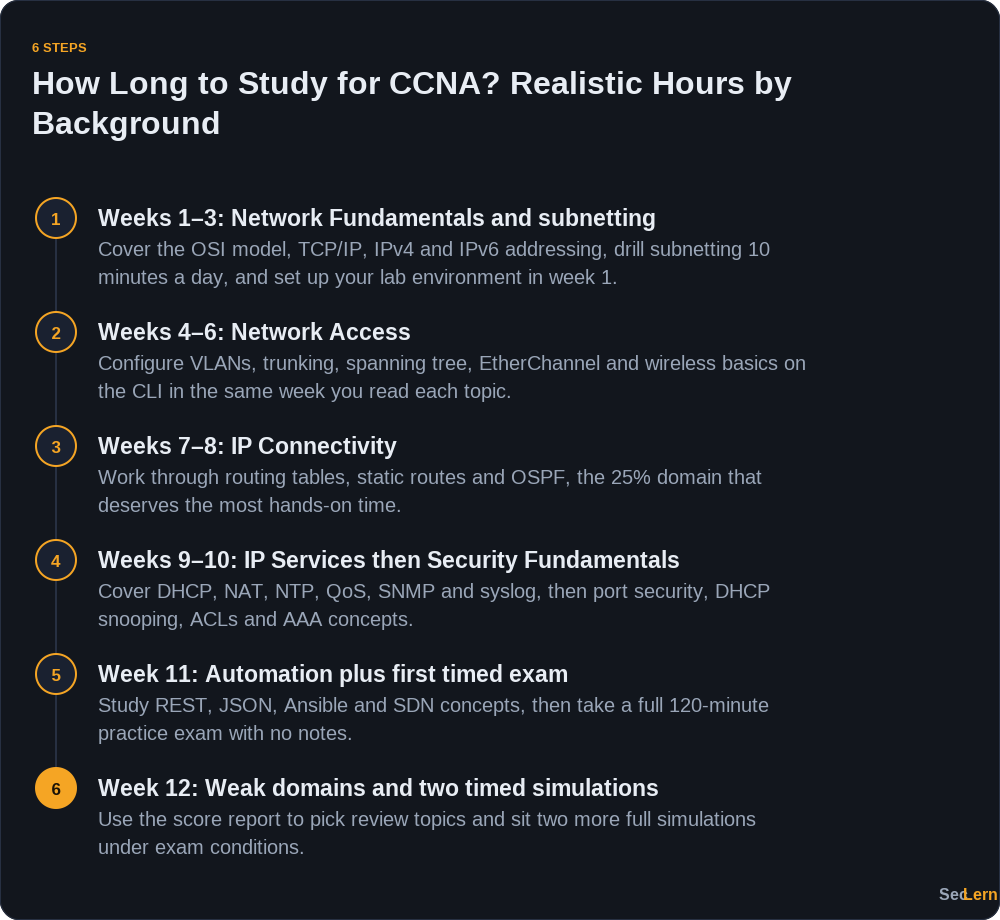
A 12-week plan suits someone who already knows basic networking, studying 10 to 12 hours a week. It spends time in proportion to the blueprint rather than covering chapters in order.
- Weeks 1–3: Network Fundamentals. OSI model, TCP/IP, IPv4 and IPv6 addressing, daily subnetting drills. Set up your lab in week 1 with Cisco labs in the browser or Packet Tracer.
- Weeks 4–6: Network Access. VLANs, trunking, spanning tree, EtherChannel, wireless. Configure every topic the week you read it.
- Weeks 7–8: IP Connectivity. Routing tables, static routes, OSPF. The heaviest domain and the one that deserves the most CLI time.
- Weeks 9–10: IP Services, then Security Fundamentals. DHCP, NAT, NTP, QoS, SNMP and syslog, then port security, DHCP snooping, ACLs and AAA concepts.
- Week 11: Automation and Programmability, plus a first timed practice exam. Take it under exam conditions: 120 minutes, no notes, no pauses.
- Week 12: weak domains and two more timed simulations. Let the score report choose what you review.
Resource mix: Jeremy's IT Lab covers the blueprint free on YouTube, Wendell Odom's Cisco CCNA 200-301 Official Cert Guide, Volumes 1 and 2, goes deeper on theory, and Neil Anderson's Udemy course is another full video path. Cisco Packet Tracer is a free simulator many people start with; Boson ExSim-Max is a paid option known for demanding practice exams.
What makes CCNA study take longer than people expect?
Most CCNA timelines slip for five predictable reasons, and none of them is a lack of talent.
- Watching videos without touching a CLI. Recognition feels like knowledge and is not. If you cannot build a trunk from a blank terminal, you have watched, not studied.
- Avoiding subnetting because it is uncomfortable. The discomfort compounds and costs both study hours and exam points.
- Leaving Automation and Programmability to the last week. A 10% domain read in a hurry is 10% of the exam answered from vague memory.
- Never taking a timed practice exam. The 120-minute pacing becomes a surprise on exam day, including when to skip a question and return.
- Restarting from chapter one after a break. A two-week pause does not erase progress; restarting does. Resume where you stopped.
How long does it take to study for the CCNA while working full time?
Working full time, the realistic budget is 8 to 12 hours a week: an hour on three or four weeknights plus a four- or five-hour weekend block. At that rate a 200-hour prep takes about 4 to 6 months, which is normal and not a sign you are behind.
Protect the weekend block for labs and practice exams, because those need uninterrupted time. Weeknights suit reading, flashcards and short drills: 20 minutes of subnetting, 15 minutes of protocol facts, 25 minutes of video.
Once your weekly hours have held for a month, book the exam 4 to 5 months out. CCNA exams are scheduled through Pearson VUE, at a test center or online with a proctor, and a booked date turns an open plan into a schedule. More on fitting study around a job: how to study while working full time.
How do you shorten your CCNA study time?
You can cut weeks off a CCNA prep without cutting corners on the blueprint. The gains come from sequencing and feedback, not longer hours.
- Book the exam date first. A deadline removes the drift that turns a 4-month plan into 12.
- Drill subnetting 10 minutes a day instead of one marathon session.
- Configure every topic the week you study it. Browser labs remove the install-and-tweak excuse that eats a weekend.
- Take a timed practice exam at the halfway point. Finding your weakest domain at week 6 beats finding it at week 12.
- Use flashcards for commands, ports and protocol facts rather than re-reading notes.
- Check your plan against the blueprint before week 1. A domain missing from your schedule will be missing from your score.
Free practice tests with a reason for every option give the fastest feedback loop: a wrong answer points straight at the domain to revisit.
Our perspective
We built SecLern's CCNA path on a simple bet: people rarely fail the CCNA because they ran out of videos. They fail because they never configured anything. So our CCNA 200-301 page pairs original questions with an explanation for every answer, right and wrong, and runs Cisco labs in the browser, which means a 45-minute evening goes into
switchport mode trunkinstead of simulator setup. The honest trade-off: a structured video course explains protocol theory better than we do, and the official cert guides go deeper still. Use those for theory, then practice by weight. If IP Connectivity is 25% of the exam, it deserves about 25% of your hands-on time, not one chapter in week 11.
Practice with SecLern
SecLern's CCNA 200-301 study page covers all six blueprint domains with original practice questions, an explanation for every answer, and browser-based Cisco labs that need no VM or cloud account. Timed simulations report readiness grades, so a weak domain shows up before exam day. The free tier needs no card: the first module of the CCNA path, 30 questions a day, 3 labs and PBQs, and unlimited flashcards. Pro is $15 a month or $99 a year with a 7-day trial, and Exam Sprint is $29 once for 90 days when you have a date booked. Details at pricing.
FAQ
Is 2 months enough to study for the CCNA?
Two months is enough only with a head start. At 15 to 20 hours a week, eight weeks gives you 120 to 160 hours, which fits someone who holds Network+ or works with networks daily. With no IT experience the planning range is 250 to 300 hours, so two months would need roughly 30 hours a week.
Can I pass the CCNA in 30 days?
A 30-day CCNA sprint works only if you already configure Cisco gear. Thirty days at three hours a day is about 90 hours, inside the range for an experienced network engineer and well short of the 250 to 300 hours a beginner needs. Otherwise, book the exam further out.
Is the CCNA harder than Network+?
Yes, the CCNA is generally harder because it tests configuration, not just recall. CompTIA Network+ N10-009 is vendor-neutral, with a maximum of 90 questions in 90 minutes, according to CompTIA. The CCNA 200-301 runs 120 minutes and asks you to configure Cisco devices, so command-line fluency counts.
How many hours a day should I study for the CCNA?
For the CCNA, aim for one to two hours on weekdays and one longer block of four or five hours at the weekend, which totals 9 to 15 hours a week. Daily consistency matters more than long sessions: 45 focused minutes with a lab open beats three passive hours of video. Keep one rest day.
Do I need to know subnetting before starting CCNA study?
No. You can start CCNA study with no subnetting skill, but you cannot pass the exam without one. Subnetting appears inside IP addressing and again in routing and access control, so build it early with 10 minutes a day, then keep using it in labs instead of treating it as a separate topic.
How long is the CCNA certification valid?
The CCNA certification is valid for three years, according to Cisco's certification page. You renew it with continuing education credits or by passing a higher-level certification exam, so recertification is ongoing. Check Cisco's page for the current credit requirements before your expiration date.
Sources
- Cisco CCNA Exam Topics (200-301 v1.1)
- Cisco CCNA Certification
- Pearson VUE: Cisco exams
- CompTIA Network+ (N10-009) Certification