
On this page
TL;DRWhat is AWS Certified Security Specialty?What does the SCS-C03 exam cost and how is it formatted?What domains does the SCS-C03 exam cover?SCS-C03 vs SCS-C02: which exam should you book?Is AWS Certified Security Specialty hard?Signs you are readyIs AWS Certified Security Specialty worth it? Salary and jobsWhat experience do you need before you start?Which course and practice tests should you use?How to get AWS Certified Security Specialty: a 6-step study planWhat does a Security Specialty-style S3 scenario look like?Our perspectivePractice with SecLernFAQWhat is the current exam code for AWS Certified Security Specialty?How hard is AWS Certified Security Specialty?How much does the AWS Certified Security Specialty exam cost?What is the passing score for AWS Certified Security Specialty?Is AWS Certified Security Specialty worth it?Do I need AWS SAA before AWS Certified Security Specialty?SourcesRecommendedAWS Certified Security Specialty is an advanced AWS certification for professionals who secure cloud workloads, and AWS lists the current exam as SCS-C03. The exam is 65 questions in 170 minutes, with a passing score of 750 on a 1,000-point scale and a USD 300 fee in the US. It is not entry-level, so build hands-on AWS security experience before you book.
TL;DR
- AWS lists AWS Certified Security Specialty as SCS-C03: 65 questions in 170 minutes, with a passing score of 750 on a 1,000-point scale.
- The exam fee is USD 300 in the US; confirm local pricing and taxes before booking.
- Infrastructure Security is the largest domain at 20%, followed by Security Logging and Monitoring and Data Protection at 18% each.
- AWS Certification exams have no formal prerequisites, but the exam assumes working knowledge of IAM, KMS, VPC, S3, CloudTrail, AWS Organizations and GuardDuty.
- Certifications are valid for three years, so budget for recertification.
- SCS-C02 still appears in older courses and question banks; check the exam code and update date before buying.
What is AWS Certified Security Specialty?
AWS Certified Security Specialty is a role-based AWS certification that validates your ability to design, implement, monitor and secure workloads on AWS. AWS's certification page lists the current exam as SCS-C03.
It is built for cloud security engineers, security architects, DevSecOps practitioners and consultants who already work in AWS and have to make accounts defensible, not just functional. It sits above the associate exams in AWS's path. Associate exams test whether you can build on AWS; this specialty tests whether you can secure what was built under real constraints such as a compliance rule, a shared account model or a break-glass requirement.
It is not a general security certificate. CompTIA Security+ SY0-701 is vendor-neutral, and ISC2 CISSP is broad and management-focused. SCS-C03 assumes you already know how IAM, KMS, VPC and CloudTrail behave when they are misconfigured.
What does the SCS-C03 exam cost and how is it formatted?
The SCS-C03 exam costs USD 300 in the US, has 65 questions, runs 170 minutes and requires 750 out of 1,000 to pass, according to AWS's exam guide and AWS's certification page.
| Item | Detail |
|---|---|
| Exam code | SCS-C03 |
| Questions | 65 |
| Time allowed | 170 minutes |
| Passing score | 750 on a 1,000-point scale |
| Fee | USD 300 in the US |
| Question types | Multiple choice and multiple response |
| Delivery | Pearson VUE test center or online proctored |
| Validity | 3 years (recertification) |
The checkout shows local pricing and taxes, so candidates outside the US should confirm the amount in the Pearson VUE scheduler before booking. Exam versions and prices change, so check the official page on the day you book, not a blog post.
The fee is not the whole cost. A course, a question bank and a retake all add up, and a retake usually means paying the exam fee again.
What domains does the SCS-C03 exam cover?
The SCS-C03 exam covers six domains, and Infrastructure Security is the largest at 20%, according to the SCS-C03 exam guide.
| Domain | Weight |
|---|---|
| Threat Detection and Incident Response | 14% |
| Security Logging and Monitoring | 18% |
| Infrastructure Security | 20% |
| Identity and Access Management | 16% |
| Data Protection | 18% |
| Management and Security Governance | 14% |
Security Logging and Monitoring and Data Protection follow at 18% each, so the three biggest domains carry most of the exam. Use the weights to split study hours, not to skip topics. Threat Detection and Incident Response and Management and Security Governance are both 14%, and they are easy to skip because they feel less technical.
If AWS updates the blueprint, the exam guide wins over any blog post, including this one.
SCS-C03 vs SCS-C02: which exam should you book?
Book SCS-C03. AWS's certification page lists SCS-C03, so SCS-C02 is the older code you will still see in course titles, blog posts and question banks.
Verify the code in three places before you spend money: the AWS certification page, the Pearson VUE scheduler at booking time, and the last-updated date on any course or practice test. A course recorded for SCS-C02 can still teach valid concepts, but you have to map its content to the current domains yourself.
If you are already scheduled for an older version, follow the instructions from AWS or Pearson VUE rather than guessing retirement dates from forums. SecLern's version comparison tool is a quick way to check which code is current.
Is AWS Certified Security Specialty hard?
Yes. AWS Certified Security Specialty is harder than the associate exams because each question asks you to apply AWS services to a scenario, not define them.
- Scenario-based questions. A stem describes a company, a requirement and a constraint such as must be auditable, least operational overhead or must not affect other accounts. Two answers are plausible; only one satisfies every constraint.
- Service depth. You need working knowledge of IAM policies and permission boundaries, KMS key policies and grants, security groups and network ACLs, S3 bucket policies and Block Public Access, CloudTrail, AWS Config, Organizations and SCPs, GuardDuty, Security Hub and Macie.
- No official pass rate. AWS does not publish one, so any guaranteed-pass claim is marketing, not data.
Signs you are ready
You can write a least-privilege IAM policy from a requirement, explain when a KMS key policy grants access that IAM alone does not, trace an API call through CloudTrail, and say why traffic was blocked by a security group rather than a network ACL.
Is AWS Certified Security Specialty worth it? Salary and jobs
It is worth it if your role already touches AWS security, or if you are moving into cloud security, DevSecOps, security architecture or consulting. It is not a first IT certification, because it assumes AWS fluency that beginners have not built yet.
Search current postings for cloud security engineer, AWS security engineer, security architect, DevSecOps engineer and cloud security consultant. Note which ones list the certification as required, preferred or absent.
Do not trust a single average salary figure. Pay depends on role, location, experience and employer. Use current postings and BLS data for information security analysts as a starting point; BLS describes the occupation, not the certificate.
The certification can help you get past a screening filter. It does not guarantee a job, promotion or raise, and it expires after three years, so plan for recertification.
What experience do you need before you start?
There is no formal prerequisite. AWS's certification FAQs state that AWS Certification exams have no prerequisites, so you do not have to pass AWS Certified Solutions Architect Associate (SAA-C03) first.
The realistic baseline is comfort with the AWS console and CLI, IAM roles and policies, VPC subnets, route tables, security groups and network ACLs, S3 bucket policies, KMS keys, CloudTrail and CloudWatch Logs. If you have never built in AWS, get that experience first, through SAA-C03 or on the job.
Use a small sandbox account with a billing alarm for practice. SecLern's SAA-C03 practice questions cover the IAM, VPC and S3 fundamentals this exam assumes, and the hands-on labs in the browser let you practice Linux and networking tasks without a VM.
Which course and practice tests should you use?
Use one course that states it is updated for SCS-C03, plus one question bank with explanations, and treat AWS's official practice questions as your calibration baseline.
- AWS Skill Builder. AWS's own training platform includes exam prep and official practice questions. Best for wording and difficulty; less useful if you need a service taught from scratch.
- Tutorials Dojo. Practice exams with timed and review modes plus detailed explanations. Good if you want to review by domain and learn from wrong answers.
- Adrian Cantrill. Long-form AWS courses with hands-on labs. Good if you want to understand how services behave instead of memorizing answers.
- A Cloud Guru (Pluralsight). Video courses and cloud sandboxes inside a subscription. Good for structured learners who want training and a playground in one place.
- Whizlabs. Question banks and practice tests. Good for volume, but check the exam code and last-updated date before buying.
Avoid exam dumps. They violate AWS's certification agreement, they can get candidates banned, and they teach recognition instead of reasoning. Use practice tests with explanations and repeat missed questions until you can explain why each distractor fails. If you keep forgetting what you reviewed, use a how to retain technical knowledge system. If you are rebuilding fundamentals, the AWS SAA practice test guide covers timed practice.
How to get AWS Certified Security Specialty: a 6-step study plan
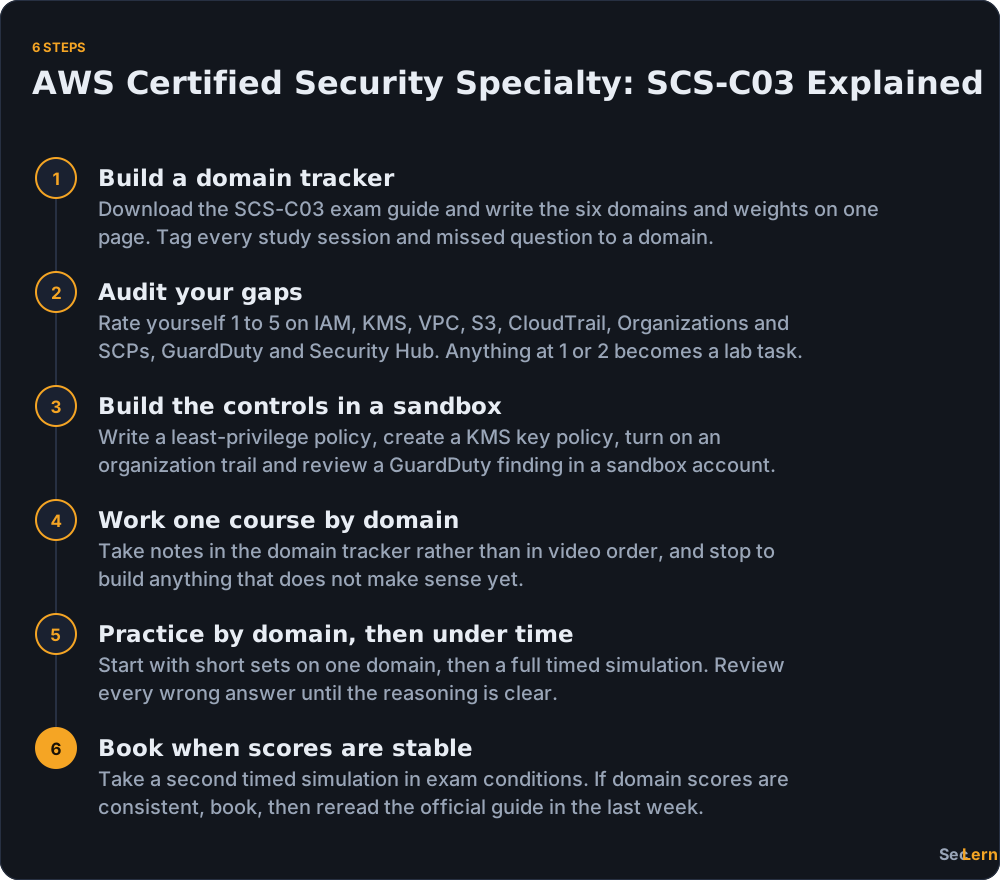
A reliable route is a six-step loop: build a domain tracker, audit your gaps, build the controls in a sandbox account, work one course by domain, practice by domain then under time, and book when your scores are stable.
- Download the exam guide and build a domain tracker. Write the six domains and weights on one page. Tag every study session and missed question to a domain, so you can see where points are leaking.
- Audit your gaps. Rate yourself 1 to 5 on IAM, KMS, VPC, S3, CloudTrail, Organizations and SCPs, GuardDuty and Security Hub. Anything at 1 or 2 becomes a lab task, not a video to rewatch.
- Build the controls in a sandbox account. Write a least-privilege policy, create a customer managed KMS key with a key policy, turn on an organization trail and review a GuardDuty finding. Reading about a control is not the same as fixing a misconfigured one.
- Work one course by domain. Take notes in the domain tracker, not in video order, and stop to build anything that does not make sense yet.
- Practice by domain, then under time. Start with short sets on one domain, then a full timed simulation. Review every wrong answer until you can explain the requirement, the constraint and why each distractor fails.
- Book when your scores are consistent. Take a second timed simulation in exam conditions: no pauses, no notes. If domain scores are stable, book, then reread the official guide and your own notes in the last week.

What does a Security Specialty-style S3 scenario look like?
A typical SCS-C03 scenario gives you sensitive logs in S3, one role that must read them, and a requirement that every decryption be auditable; the answer is layered controls, not one service.
Scenario: A company stores sensitive application logs in an S3 bucket. Only a specific security role should read them, every decryption must be auditable, and the logs must not be publicly accessible.
The objectives are confidentiality, least privilege and auditability. No single checkbox satisfies all three.
- Block public access at the account and bucket level. S3 Block Public Access stops a future bucket policy from accidentally opening the bucket.
- Deny non-TLS requests in the bucket policy. A statement with a
Denyeffect ons3:*whenaws:SecureTransportisfalseforces HTTPS. - Scope the role to the prefix. The IAM role gets
s3:GetObjecton the specific prefix, nots3:*on the bucket, and no permission to delete or overwrite. - Use a customer managed KMS key. The key policy grants
kms:Decryptto the security role and keeps key administration with a separate admin role. An IAM policy alone is not enough for a KMS key. - Turn on CloudTrail data events for S3 and include KMS in the organization trail. Object-level S3 events and KMS API calls go to a locked-down log bucket in a separate account, so a compromised workload account cannot erase the evidence.
- Add detection. GuardDuty, Macie findings or an alarm on unusual
GetObjectvolume gives you a chance to notice misuse.
Each control covers a different failure, which is the defense-in-depth idea described in AWS's Security Pillar. Exam takeaway: read the requirement and the constraint first, then pick the control that satisfies both. The most familiar service is often a distractor.

Our perspective
We built SecLern around the idea that you learn security by doing the task, not by watching someone else do it. The candidates who struggle with SCS-C03 rarely fail on service names. They fail on constraints: they pick the control they recognize instead of the one that satisfies least privilege or auditability in the stem. Our honest trade-off is that SecLern's closest AWS path today is SAA-C03, not the Security Specialty. That is where IAM policies, KMS key policies and S3 bucket policies get fluent. If you already hold SAA-C03, spend your money on one good SCS-C03 question bank with explanations rather than a second video course.
Practice with SecLern
SecLern's AWS coverage starts with the AWS Solutions Architect Associate (SAA-C03) study page. It builds the IAM, VPC, S3 and KMS fluency the Security Specialty assumes: original practice questions with an explanation for every answer, full timed exam simulations with readiness grades, and hands-on labs in a simulated browser desktop. The free tier includes the first module, 30 questions a day, 3 labs and PBQs, no card needed. Pro is $15 a month or $99 a year with a 7-day trial. Exam Sprint is $29 once for 90 days. Details on pricing.
FAQ
What is the current exam code for AWS Certified Security Specialty?
AWS's certification page lists AWS Certified Security Specialty as SCS-C03. Older courses, blog posts and question banks still use SCS-C02, the previous code. Check the code on the AWS certification page and again in the Pearson VUE scheduler on the day you book, because AWS controls exam versions and the code can change.
How hard is AWS Certified Security Specialty?
Harder than the AWS associate exams. Questions are scenario-based and assume working knowledge of IAM, KMS, VPC, S3, CloudTrail, Organizations, GuardDuty and Security Hub. AWS publishes no pass rate, so judge readiness by whether you can design least-privilege access, read a KMS key policy and trace an event through CloudTrail, not by third-party pass-rate claims.
How much does the AWS Certified Security Specialty exam cost?
The fee is USD 300 in the US, according to AWS's certification page. The checkout shows local pricing and taxes, so confirm the amount for your country before booking. Courses, practice tests and any retake cost extra, so budget for more than the exam fee itself.
What is the passing score for AWS Certified Security Specialty?
750 on a scale of 1,000, according to the SCS-C03 exam guide. AWS reports a scaled score, not a simple percentage of correct answers, so do not assume you need exactly 75% right. AWS does not publish per-question scoring or a breakdown of how many questions you must answer correctly.
Is AWS Certified Security Specialty worth it?
Yes if your role already involves AWS security, or you are moving into cloud security, DevSecOps, security architecture or consulting. It is weaker as a first certification because it assumes AWS fluency. It can help you pass a screening filter, but it does not guarantee a job, promotion or specific salary, and it expires after three years (recertification).
Do I need AWS SAA before AWS Certified Security Specialty?
No. AWS Certification exams have no formal prerequisites, according to AWS's certification FAQs, so you can book the Security Specialty without SAA-C03. Most candidates still benefit from associate-level fluency in IAM, VPC and S3, built through SAA-C03 study or hands-on work. If you have never built in AWS, start there.
Sources
- AWS Certified Security – Specialty
- AWS Certified Security – Specialty (SCS-C03) Exam Guide
- AWS Certification Recertification
- AWS Certification FAQs
- AWS Well-Architected Framework: Security Pillar
- BLS Occupational Outlook Handbook: Information Security Analysts